
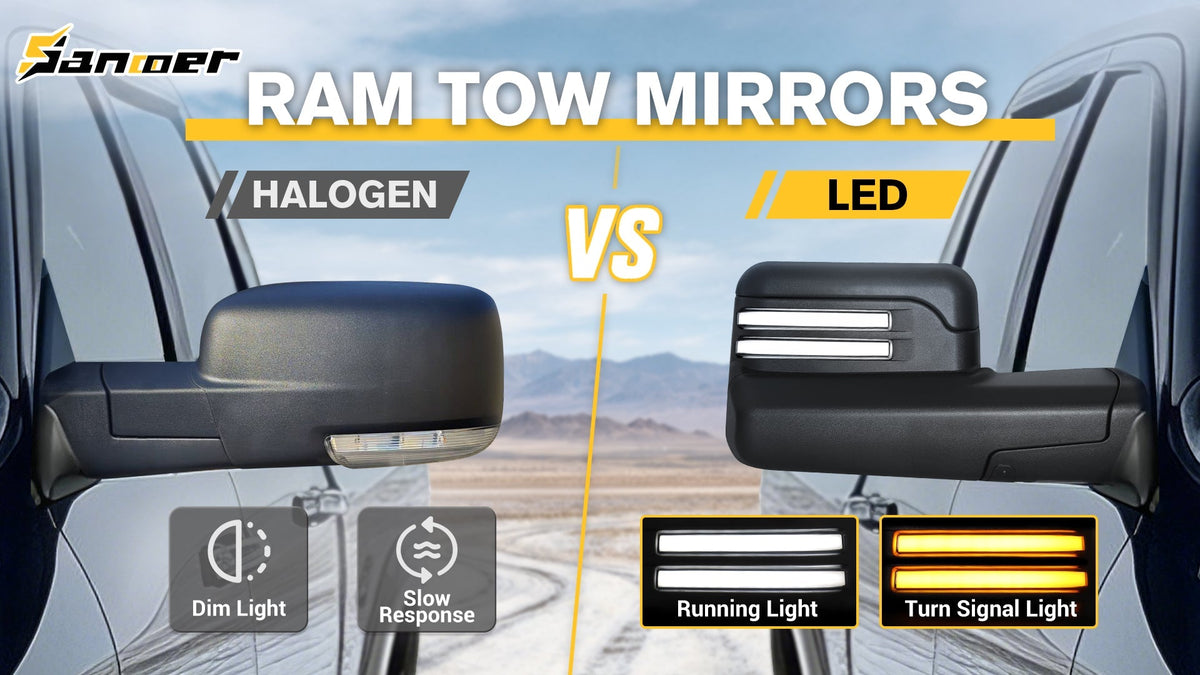
When hauling heavy loads or backing up a wide trailer, clear side optics on your Dodge Ram are essential. Factory halogen mirrors served heavy-duty truck owners for years, but modern solid-state LED technology has redefined visibility, longevity, and safety on the road.
If you are looking to replace a damaged side mirror or upgrade your Dodge Ram’s factory setup, understanding the functional differences between halogen and LED towing mirrors from Sanooer is crucial. This guide covers technical distinctions, performance comparisons, and key purchasing criteria to help you choose the ideal setup for your build.
|
Feature |
Halogen Towing Mirrors |
|
|
Illumination Source |
Tungsten Filament Bulb |
Solid-State Diodes |
|
Color Temperature |
Warm Yellow (~3000K) |
Cool White / Pure Amber (~6000K) |
|
Activation Speed |
Slow (~200ms filament warm-up) |
Instantaneous (0ms delay) |
|
Thermal Output |
High Operating Temperatures |
Low Operating Temperatures |
|
Service Life |
~1,000–2,000 Hours |
~30,000–50,000+ Hours |
|
Special Functions |
Basic On/Off Flashing |
Sequential Turn Signals & Running Light Bars |
Halogen vs. LED: Key Performance Factors
1. Signaling Speed and Safety Margin
Standard halogen bulbs rely on thermal filament heating to generate illumination, introducing a slight delay (~200 milliseconds) from the moment you signal. Solid-state LED arrays ignite instantaneously. At 65 mph, that fraction of a second gives trailing drivers up to 20 feet of additional braking distance—a vital safety buffer when changing lanes with a heavy trailer attached.
2. Light Output and Daytime Contrast
Halogen signals produce a dim, yellowish glow that easily gets washed out under harsh direct sunlight or heavy downpours. High-output amber and white LEDs deliver crisp contrast, ensuring your turn signals, clearance lights, and puddle lamps remain highly visible during daytime towing and adverse weather.
3. Energy Efficiency and Durability
Heavy-duty trucks face intense vibration, rough job sites, and corrugated backroads. Halogen filaments are brittle and susceptible to snapping under continuous severe road shock. In contrast, LEDs feature solid-state construction with no delicate components to break, consuming less power while operating cooler over a significantly longer lifespan.
4. Halogen Is Simpler—but That Doesn't Always Make It Better
Halogen has one major advantage that shouldn't be overlooked:
It's a mature and familiar technology.
Replacement bulbs are widely available, and technicians are familiar with conventional halogen electrical systems.
But in a towing mirror, the lighting assembly itself is only one part of the equation.
The mirror still needs to provide the functions the truck owner actually wants.
If your goal is simply to replace a failed traditional light, a conventional setup may be sufficient.
If you're building a more modern towing setup with integrated signaling and additional lighting functions, LED offers considerably more possibilities.
5. What About Sequential LED Tow Mirrors?
For many Ram owners, this is where the comparison gets interesting.
A sequential signal doesn't simply turn the LEDs on and off.
The sweeping effect can make the mirror look substantially more modern.
But remember that sequential lighting is primarily a lighting design/function choice, not a substitute for a properly sized towing mirror.
The mirror glass, viewing area, adjustment range, and towing position remain more important to the actual towing function.
Choose Halogen Towing Mirrors If:
You Need a Strict Budget OEM Replacement: If you are repairing a fleet truck or base-trim Ram work truck and simply need to match stock specs without modifying electrical configurations, standard halogen mirrors provide an economical solution.
Your Truck Lacks Auxiliary Wiring: Older base-trim Dodge Rams without factory signal or puddle light options can run halogen mirrors without requiring additional wiring taps or modules.
Choose LED Towing Mirrors If:
You Tow Frequently at Night or Long Distances: The increased lumen output of LED running lights and puddle lamps provides superior field visibility, making night maneuvering, hitching, and lane changes significantly safer.
You Want Modern Aesthetics & Advanced Signaling: Modern LED kits integrate dynamic features like sequential turn signals and continuous light bar running lamps that give older Dodge builds a modern, heavy-duty appearance.
You Want a Long-Term Upgrade: Eliminating recurring halogen bulb burnouts saves time and maintenance costs over the lifespan of your truck.
Cost, Maintenance & Long-Term Value
When deciding between halogen and LED towing mirrors for your Dodge Ram, evaluating the total cost of ownership goes beyond the initial purchase price.
Initial Upfront Investment: Halogen towing mirrors carry a lower entry price, making them an appealing short-term choice for budget-conscious repairs or fleet vehicles. LED towing mirrors require a higher initial investment due to integrated diode arrays, internal driver boards, and premium housing materials.
Maintenance & Replacement Frequency: Halogen bulbs have a limited operating lifespan (typically 1,000 to 2,000 hours) and are highly sensitive to road vibrations. Over a truck’s lifetime, recurring halogen bulb replacements—and the labor required to disassemble mirror housings to swap them—add unexpected costs and downtime. Solid-state LEDs last up to 50,000+ hours, effectively offering a lifetime lighting solution without maintenance.
Resale Value & Truck Aesthetics: Aesthetic appeal directly impacts heavy-duty truck resale value. Halogen mirrors with faded, yellowing output make older Rams look neglected. Upgrading to sleek LED mirrors with dynamic signals instantly modernizes your truck’s profile, making it far more attractive to prospective buyers on the used market.
Have questions about tow mirror compatibility, wiring harnesses, or upgrading your stock setup? Explore Sanooer full catalog of vehicle-specific towing mirrors or reach out to our team for technical assistance!

Leave a comment
All comments are moderated before being published.
This site is protected by hCaptcha and the hCaptcha Privacy Policy and Terms of Service apply.