
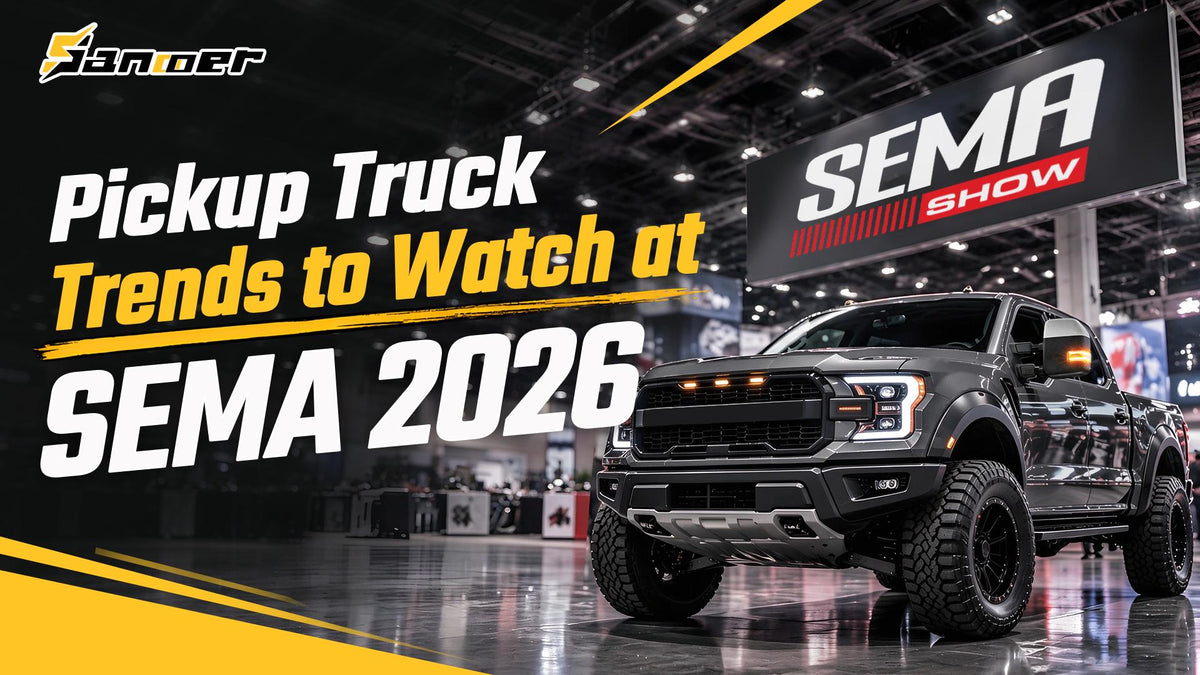
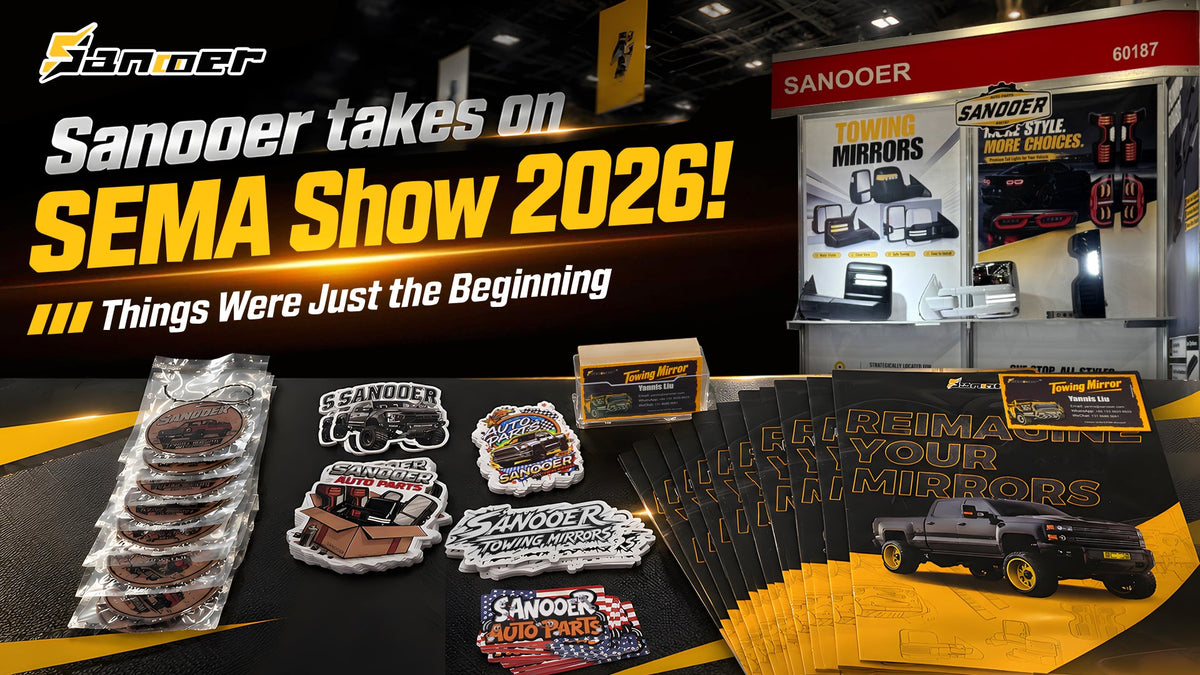
Every November, the Las Vegas Convention Center becomes the world's largest focus group for truck owners. SEMA 2026, running November 3–6, is no exception — more than 2,000 brands across a million-plus square feet of indoor space, with the Trucks, SUVs & Off-Road section anchored in West Hall and, for the first time, sitting shoulder to shoulder with an expanded Powersports, SxS & Lifestyle section. And of course, Sanooer Autoparts was once again there as an exhibitor this year, just as promised.
That adjacency is the story in miniature. The line between "work truck," "overland rig," and "adventure vehicle" has effectively dissolved. Builders no longer ask whether a truck can tow; they ask whether it can tow, camp, haul bikes, run a job site, and still look right in a parking lot on Monday morning.
Here's what that looks like on the floor this year — and why tow mirrors, the least glamorous part on the truck, deserve more of your attention than they're getting.
The Numbers Behind the Sheet Metal
SEMA's 2026 market report makes the case better than any booth display can:
Pickups are the single largest vehicle segment in the aftermarket — $15.0 billion in specialty-equipment spending, roughly 30% of all industry sales.
That is why the West Hall feels less like a trade show and more like a family reunion — and why the product decisions made on that floor in November set the retail catalog for the next eighteen months.
Trend 1: Exterior Design Is Getting Functional Again
For a few years, the loudest trucks at SEMA were loud in the styling sense: wide flares, giant wheels, cosmetic armor. The 2026 floor skews harder toward parts that do something.
· Bed utility systems are the new battleground — reinforced mounting plates, adjustable cleats, rail-mounted racks, cargo dividers. Ford's BoxLink-style corner plates and the aftermarket's response to them show how much value lives in a factory anchor point.
· Overlanding architecture keeps expanding: roof platforms, bed racks, rooftop-tent mounting systems, awning brackets, and the wiring that has to feed all of it. SEMA explicitly flags racks, cargo management, and rooftop platforms as a growing lifestyle segment.
Trend 2: Functional Upgrades Now Start With Weight, Not Lift
The second shift is philosophical. The conversation at SEMA has moved from "how tall" to "how much, and how safely."
· Onboard scales and smart hitch systems (Ford's Onboard Scales with Smart Hitch being the reference implementation) put real payload and tongue weight on the center screen instead of in a guessing game.
· Air suspension and auto-leveling are being spec'd for the way a truck actually behaves when a trailer drops onto the ball — headlight aim, steering feel, brake balance.
Trend 3: Lighting Has Become a Safety Language
Lighting is where the 2026 show floor is loudest — and not just in lumens.
Sequential and switchback signaling has gone from niche to near-standard on aftermarket tow mirrors and mirror caps. It's decorative at first glance, but there's a functional argument underneath: an animated, high-contrast amber signal sits in a driver's peripheral vision longer than a static bulb flash, and it reads clearly at the width of a trailer.
Other patterns worth noting:
· Smoked and clear lens options for owners who want the function without the chrome-era look. Verify local lighting regulations before shipping these into a new market. [Click here to view Sanooer smoked mirror lenses]
· Dual-function running/turn lamps that keep the mirror visible at dusk without glare.
 · Puddle and spot lamps integrated into mirror housings — genuinely useful for hitching up in an unlit lot at 5 a.m.
· Trailer-side lighting and hitch lamps. Ram's tailgate-integrated LED hitch light is a small feature that solves a real, repeated frustration. Expect the aftermarket to answer it.
The compliance note nobody prints in the catalog: lighting color, flash pattern, and brightness rules vary by state and by market. A sequential amber signal is generally safe; a red or blue forward-facing accent is not. Document the intended use, and don't let a stylist make a legal decision.
Trend 4: Tow Mirrors Are the Quiet Centerpiece
Here's the argument: the tow mirror is the only part on a pickup that is simultaneously a visibility device, a lighting device, an ADAS sensor housing, a camera platform, and a styling statement — and it's the part most builds still treat as an afterthought.
At SEMA 2026, that's changing. Mirror suppliers are showing up with engineering stories rather than part numbers, because the mirror is where the truck's electronics and the owner's actual use case collide.
From clip-on to full replacement
The category has stratified into three tiers, and each has a legitimate buyer:
|
Tier |
Typical buyer |
Strength |
Trade-off |
|
Clip-on extension |
Tows 3–10 times a year; leased truck |
Installs in minutes, fully reversible, leaves factory electronics untouched |
Vibration at highway speed, added width, no electrical features |
|
Direct-fit replacement, manual telescope |
Older trucks, budget-conscious towers |
Large glass area, flat + convex split, factory mounting points |
No power fold/extend, install requires door panel removal |
|
Upgraded replacement (power telescope/fold, heat, signal, camera, BSM retention) |
Monthly+ towers, HD trucks, fleet |
OEM-level integration, retains safety systems, best glass |
Highest cost; fitment and calibration complexity |
The spec sheet buyers should demand
· Vehicle year, make, model, cab and door configuration, and trim
· Factory mirror features present (power fold, telescope, heat, BSM, camera, memory, puddle lamp)
· Extended vs. retracted width
· Whether the housing retains the OEM camera and radar mounting points
· Whether calibration is required after install
· Torque spec and hardware grade
That list is also a merchandising opportunity. Retailers who put it on the shelf edge sell fewer returns and more second pairs.
Trend 5: Towing Accessories Are Getting Smarter, Not Just Stronger
If mirrors are the visibility layer, the rest of the tow ecosystem is the data layer — and SEMA 2026 shows it consolidating.
· Trailer TPMS is moving from aftermarket add-on to expected feature. Ram's cluster can display trailer tire pressure for up to four trailers; Hamaton used the show to expand its heavy-duty TPMS line with band- and valve-mounted sensors for 17.5- to 24.5-inch wheels; Bartec is pushing BLE, RFID, and Wi-Fi-connected service tools. Commercial TPMS isn't federally mandated in the U.S. yet, but the industry is behaving as though it soon will be.
· Trailer cameras have gone mainstream — wired tow-mode cameras, auxiliary camera inputs, and 360-degree trailer surround views are now spec-sheet line items, not exotic upgrades.
· Smart connectors and light check routines turn a pre-trip walkaround into a 30-second screen check.
· Trailer-side power (lithium banks, DC-DC charging, solar) is driving demand for clean 7-pin integration and proper breakaway and charge-line hardware.
· Receiver hitches, weight distribution, and brake controllers remain the highest-consequence, lowest-glamour category on the floor. They're also where a knowledgeable counter person creates the most loyalty.
The pattern is the same one driving mirrors: the accessory is no longer a standalone object; it's part of a system that has to talk to the truck.
What This Means If You Sell, Build, or Spec Trucks
Three practical takeaways from the 2026 floor:
1. Bundle visibility, don't sell parts. A customer buying a 30-foot travel trailer needs mirrors, a brake controller, a weight-distribution setup, and a TPMS conversation — in that order of "why didn't anyone tell me." Package it.
2. Lead with retained function, not features. Keeps your BLIS, your 360 camera, and your power fold with sequential LED switchback with a 2025+ truck owner.
The Bottom Line
SEMA 2026 is a show about capability, and capability on a pickup is mostly a visibility problem in disguise. You can bolt on 35s, a 3-inch lift, and 20,000 lumens of forward lighting, and still merge blind because the trailer is wider than the mirror.
Walk the West Hall this week and count how many builds are running clip-ons on a truck that cost $70,000. Then count how many are running properly integrated replacements.
That gap is the opportunity.
Sources: SEMA and SEMA Show 2026 show announcements and market report coverage; 2026 Ford Super Duty and Ram 2500 factory feature documentation; SEMA 2025 post-show trend reporting; manufacturer product announcements from the SEMA 2026 floor. Market sizing figures are third-party estimates and should be treated as directional.
For other needs, explore Sanooer full catalog of vehicle-specific towing mirrors now! And feel free to check out Sanooer Youtube channel and social media platforms to explore more content that interests you!

Leave a comment
All comments are moderated before being published.
This site is protected by hCaptcha and the hCaptcha Privacy Policy and Terms of Service apply.