
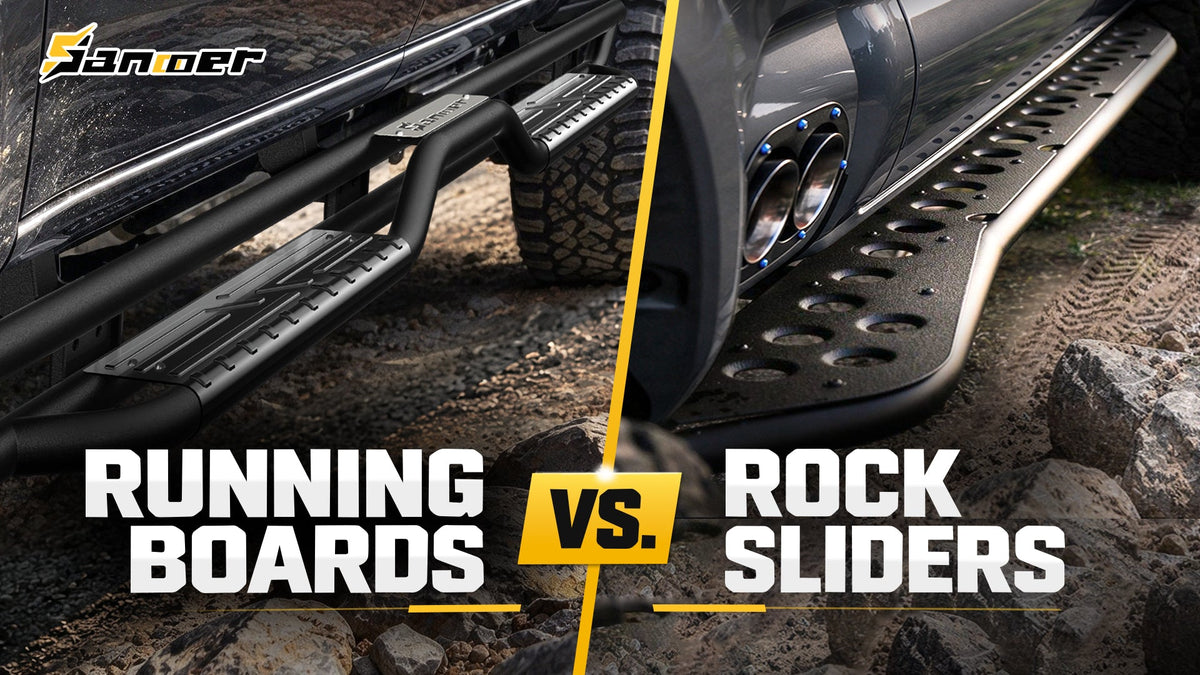
When you’re customizing your rig for better utility, style, or off-road capability, side steps are usually near the top of the list. But if you’ve started shopping, you’ve likely noticed two terms thrown around that look somewhat similar on the surface: Running Boards and Rock Sliders.
While both mount along the rocker panels beneath your cab doors, they are built for entirely different purposes, weight tolerances, and driving styles. Choosing the wrong one can mean either overpaying for heavy steel you’ll never use or crushing your truck’s bodywork on a trail obstacle.
In this guide, we’ll break down the structural differences, pros and cons, and real-world applications of running boards versus rock sliders so you can make the right call for your pickup.
At a Glance: Key Differences
|
Feature |
Running Boards |
Rock Sliders |
|
Primary Purpose |
Easy cab entry/exit & road debris protection |
Body armor against rocks, stumps, and trail obstacles |
|
Primary Material |
Aluminum, light tubular steel, or molded plastic |
Heavy-duty DOM or HREW structural steel tubing |
|
Mounting Location |
Factory body mounts / rocker panel holes |
Direct-to-frame (welded or heavy bolt-on) |
|
Weight Capacity |
~300–500 lbs (foot traffic step load) |
4,000+ lbs (capable of supporting full vehicle weight) |
|
Hi-Lift Jack Point |
❌ No (will damage body panels) |
✅ Yes (designed for off-road recovery jacking) |
|
Ideal Driver |
Daily drivers, towing rigs, family trucks, work sites |
Off-roaders, rock crawlers, overlanders |
What Are Running Boards?
Running boards are wide, flat steps that flush-mount against the bottom of your truck’s cab. They run the full length of your passenger doors (or extend wheel-to-wheel for easier bed access) and typically feature rubberized or textured stepping pads for all-weather grip.

Advantages of Running Boards
Effortless Entry & Exit: Running boards offer the widest stepping surface of any side step option. If your truck has a lift kit or oversized tires, they make getting in and out comfortable for kids, passengers, and older adults.
Door Ding & Debris Shield: While not built for rock impact, running boards act as an effective baffle against gravel, mud, and road salt thrown up by your front tires, preserving your lower paint finish.
Sleek, Factory Look: Modern running boards complement the contours of late-model Ford F-Series, Chevy Silverado, GMC Sierra, and Ram trucks without adding unnecessary bulk.
Limitations
Reduced Ground Clearance: Running boards hang below the rocker panel, slightly reducing your ramp breakover angle.
Low Impact Resistance: Because they mount to the sheet metal rocker panels rather than the structural frame, taking a hard hit from a rock or high curb will buckle the board directly into your truck's body panels.
What Are Rock Sliders?
Rock sliders are heavy-duty armor constructed from thick-wall steel tubing (often 1.75" to 2" DOM tubing). Unlike cosmetic steps, rock sliders are engineered to absorb the full weight of your vehicle dropped directly onto a boulder.
Instead of denting, they allow your truck to "slide" over rocks, logs, and steep ledge crests—hence the name.

Advantages of Rock Sliders
Uncompromised Frame Protection: Sliders bolt or weld directly to your truck’s frame rails. When off-roading, any impact is transferred across the rigid frame rather than crushing your cab doors or rocker panels.
Off-Road Recovery Points: Sliders serve as sturdy jacking points for Hi-Lift recovery jacks, making tire changes or winch setups in deep mud or uneven terrain much safer.
Kick-Out Protection: Many rock sliders feature a rear "kick-out" angle that physically pushes the rear quarter panel away from trees and rocks as you navigate tight trail turns.
Limitations
Weight: A set of heavy-duty steel sliders can add 100 to 180 lbs to your truck, slightly impacting payload capacity and fuel economy.
Narrow Stepping Surface: While some sliders feature welded top plates for foot traction, the round tubing offers a narrower foothold compared to flat running boards.
How to Choose the Right Setup for Your Truck
Ask yourself these three practical questions before pulling the trigger:
1. Where Does Your Truck Spend 90% of Its Time?
Pavement, Highway Towing & Light Dirt Roads: Go with Running Boards. They provide maximum daily convenience, keep your interior clean, and shield your paint from highway kick-up when hauling a trailer.
Rock Crawling, Technical Trails & Overlanding: Choose Rock Sliders. A single repair bill for crushed rocker panels often costs significantly more than a quality set of sliders.
2. Who is Riding in Your Truck?
If your pickup serves double duty as a family vehicle or work truck, accessibility matters. The flat, wide surface of running boards ensures safe footing in rain, ice, or snow.
3. What Other Upgrades Are on Your Truck?
Vehicle modifications work best as a system. For example:
If you’ve upgraded to extended towing mirrors and haul heavy loads, running boards help maintain a clean, balanced OEM+ appearance while offering easy cabin access during long road trips.
If your rig features high-clearance bumpers, skid plates, and aggressive off-road tires, rock sliders complete the protective armor package.
Final Verdict
Both running boards and rock sliders excel at what they were designed to do:
Choose Running Boards for maximum stepping comfort, paint protection against road debris, and a clean everyday look.
Choose Rock Sliders for indestructible off-road armor, frame-mounted jacking capability, and peace of mind on rugged trails.
Evaluate your driving habits, terrain demands, and clearance needs to equip your rig with the protection that best supports your next adventure!
Have questions about running boards, tow mirror compatibility, wiring harnesses, or upgrading your stock setup? Explore Sanooer full catalog of vehicle-specific towing mirrors or reach out to our team for technical assistance!

Leave a comment
All comments are moderated before being published.
This site is protected by hCaptcha and the hCaptcha Privacy Policy and Terms of Service apply.