
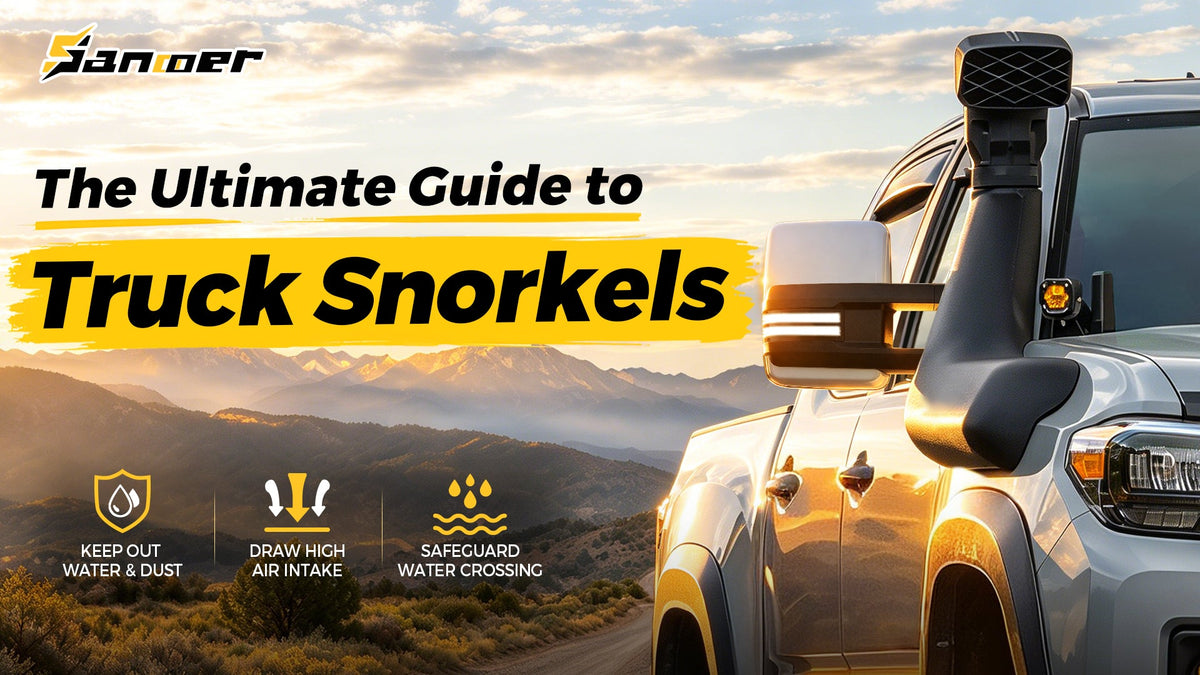
Whether you are hauling a heavy travel trailer into the backcountry or tackling deep muddy trails on a weekend expedition, overlanding tests every limit of your rig. When you're out in the wild, vehicle awareness is everything. Just as Sanooer full-view towing mirrors are essential for eliminating blind spots and keeping an eye on your trailer in rugged terrain, a raised air intake—commonly known as a snorkel—is designed to protect what’s under the hood when the path gets unpaved.
While snorkels give your pickup an undeniable, rugged off-road aesthetic, they are far more than a visual flex. In this deep dive, we’ll break down why snorkels exist, the mechanical engineering behind how they work, and the real-world honest pros and cons from drivers who rely on them in the wild.

Why Were Snorkels Created? (Manufacturing & Engineering Purpose)
Under the hood of every modern gas or diesel truck, your engine acts like a massive air pump. For combustion to take place efficiently, the engine needs clean, cool air.
By default, most factory air intakes are located inside the wheel well or near the front grill. While this setup works perfectly for highway cruising and light towing, it creates critical vulnerabilities during off-road driving and severe weather:
Hydrolock Risk: Crossing deep rivers, creeks, or flooded roads can easily push water into the factory intake line. If water enters the engine cylinders, it causes hydrolock—a total engine failure that frequently destroys pistons, rods, and engine blocks.
Dust and Debris Ingestion: When driving in a convoy on dusty desert trails, the factory air intake sucks in huge clouds of heavy dust stirred up by the tires in the wheel wells. This clogs air filters rapidly and introduces abrasive particles into your engine.
The Solution: Engine manufacturers and off-road engineers designed raised air intakes (snorkels) to relocate the air intake point from the low wheel well up to the vehicle’s roofline, securing access to cleaner, cooler, and drier air.
Mechanical Principles: How Does a Snorkel Work?
The mechanics of a snorkel are straightforward yet remarkably effective, operating on three core principles:
A. Elevating the Air Intake Line
Air density, temperature, and dust concentration vary significantly with height. Dust kicked up by truck tires remains heaviest near the ground (0–3 feet). Raising the intake point to the roofline (6+ feet) ensures the engine draws in ambient air that contains up to 90% less particulate dust.
B. The Ram-Air Effect & Cool Air Intake
When driving at highway speeds, the forward-facing scoop acts as a funnel. This creates a mild ram-air effect, forcing high-velocity air into the intake tract. Additionally, air drawn from above the hood level is several degrees cooler than the heat trapped inside the engine bay. Cooler air is denser, providing richer oxygen levels for engine combustion.
C. Centrifugal Dust and Water Separation
Ever wonder what happens when it rains heavily while driving? High-quality snorkel heads (such as Air Ram heads) are engineered with built-in moisture separators. As rain or heavy dust enters the scoop, centrifugal force slings water droplets and heavy dust particles against the outer walls, draining them out through engineered moisture slots before the air reaches your filter box.
The Realities (Cons & Trade-offs)
Physical Body Modifications Required: Installing a snorkel requires cutting a 3-inch to 4-inch hole in your truck's front fender sheet metal. For many owners, drilling into factory metal can be nerve-wracking.
Increased Wind Resistance & A-Pillar Visibility Adjustments: Because the snorkel sits along the A-pillar, it adds a bit of wind noise at highway speeds. Tip: Having properly positioned, high-visibility towing mirrors helps maintain a complete 360-degree view around your rig, offsetting any minor obstruction near the front A-pillar.
Clearance Considerations: Adding height near your roofline means you must be mindful of low-hanging tree branches on tight forest trails and overhead garage clearances.
Final Verdict: Building a Fully Protected Rig
If your truck primarily handles highway commutes, neighborhood towing, and light gravel roads, a snorkel is likely unnecessary.
However, if your adventures involve overlanding, deep trail exploration, convoy desert driving, or remote water crossings, a snorkel is one of the most effective insurance policies you can install for your engine.
True trail readiness comes down to total vehicle capability and situational awareness. Pair your snorkel with a set of Sanooer heavy-duty full-view towing mirrors to keep your eyes on the trail behind you while your engine breathes clean air ahead. With the right setup, you can conquer any remote wilderness route with complete confidence.
What about your build? Have you installed a snorkel on your truck, or are you planning one for your next overland build? Explore Sanooer full catalog of vehicle-specific towing mirrors now!


Leave a comment
All comments are moderated before being published.
This site is protected by hCaptcha and the hCaptcha Privacy Policy and Terms of Service apply.